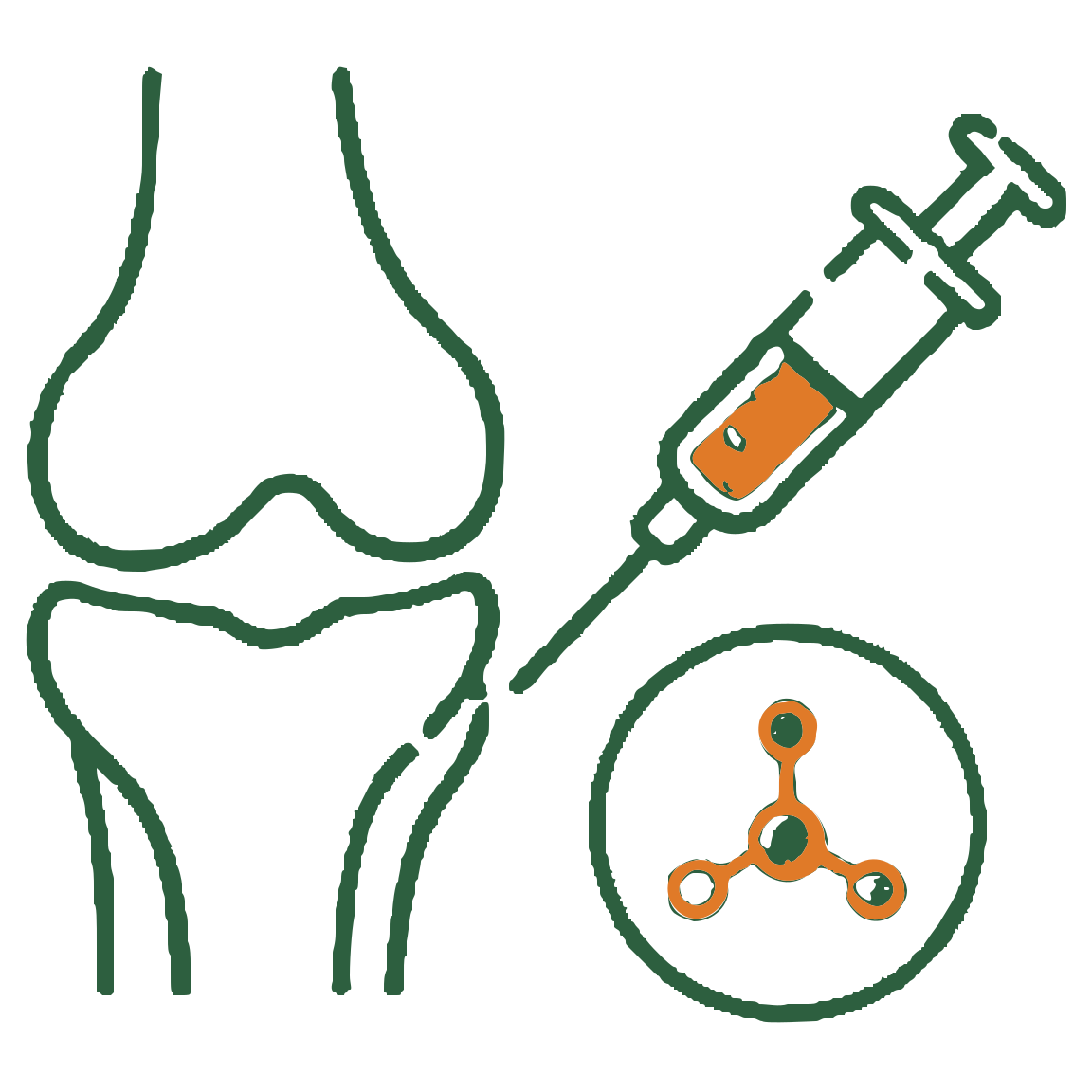

Hyaluronic acid is a natural joint fluid. With osteoarthritis, one's own production decreases; an injection supplements this and lubricates the joint. Particularly effective for mild to moderate knee osteoarthritis.
On this page11
How does it work?
Hyaluronic acid is injected into the joint space under sterile conditions (possibly ultrasound-guided). There are preparations with low and high molecular weight. We give high molecular weight preparations in a single injection (“single-shot”); low molecular weight preparations typically in a series of 3-5 weekly injections.
The hyaluronic acid lubricates the joint, dampens shocks and also seems to have an anti-inflammatory effect. The effect builds up gradually.
What can you expect?
The session lasts 15-25 minutes. The injection is comparable to a regular injection; sometimes the joint feels “full” for a moment after injection. Slight swelling or feeling of warmth possible in the first 48 hours. Do not put heavy weight on the joint for 24 hours.
Scientific substantiation
Meta-analysis (2020) showed that high-molecular hyaluronic acid improves both pain and function in knee osteoarthritis. International orthopedic guidelines place it as an option between conservative treatment and surgery.
More about this treatment
Joint wear is becoming increasingly common and can cause a lot of discomfort. You can read here what you will notice and why an injection with hyaluronic acid will change this.
The joint is dry
Patients with joint wear often say it themselves: that joint should be lubricated. As if it is dry. The complaints we hear:
- a grinding feeling in the joint
- a creaking sound when moving
- a joint that becomes less flexible
- pain when turning over in bed
- pain with movement
This usually involves the knee, hip or thumb joint. It is precisely these joints that are suitable for treatment with hyaluronic acid.
Why a worn joint becomes stiff
A healthy joint naturally produces lubricant. But as the joint wears out and ages, that production steadily decreases. The joint becomes stiff and stiff. And that accelerates wear again — so the problem perpetuates itself.
A stiff and stiff joint is also more likely to develop inflammation. These are the people who come to us with a thick, swollen, red and painful joint with fluid in it.
Such a joint needs replenishment of the lubricant to continue to function properly. Hyaluronic acid works much like lubricating oil in a stiff hinge. It is very similar to the synovial fluid that your body produces itself, which is why it is a safe drug. We use hyaluronic acid of the highest quality, purity and duration of action.
The treatment is for people who do not want joint replacement surgery. Because they are too young for it. Or too old. Or because they want to postpone such an operation for as long as possible.
Are you eligible?
The treatment is not suitable for everyone. That is why we assess this first, with a movement examination of the knee and an assessment of any X-rays.
Several factors determine whether hyaluronic acid will work for you. Many people with osteoarthritis regularly have inflammation in the joint and painful structures around it. These are the people who have a lot of pain at night. Who have difficulty getting up and down the stairs. Who cannot walk for long without pain. For whom the knee is warm and swollen, or who cannot exert much force with their thumbs. A large part of the pain complaints often arise from these inflammations and those structures, and a worn-out joint is extra vulnerable to this.
First the preparation, then the injection
If we do nothing about this and only inject hyaluronic acid into the joint, there is a good chance that the function and load-bearing capacity of the joint will not remain optimal. That is why we work with a protocol with a preparatory process. We first treat the inflammations, painful tendons, muscle attachments and ligaments. In this way we tackle all possible causes of the pain. This step partly determines the result of the treatment.
Maintenance
On average, treatment with hyaluronic acid must be repeated 3 to 4 times a year to keep the joint lubricated and to prevent complaints and inflammation. Treating and maintaining a worn joint is therefore an ongoing process, with one goal: to delay a new joint for as long as possible, or to prevent it altogether. We coordinate each treatment and maintenance process personally with you.
View the costs and reimbursements and make an appointment to find out whether you qualify.
Read more in our blog
- You don't want a new knee yet, but you do want to get rid of the complaints. What can we do for you?
- Position of the Dutch Orthopedic Association (NOV)
This is how a session goes
Each process is tailor-made, but this is what a typical course looks like — from first intake to pain-free and maintenance. You always know exactly where you stand.
Sterile preparation
Skin disinfection of the injection site. Local anesthesia if desired.
Intra-articular injection
Hyaluronic acid directly into the joint space, often ultrasound-guided for precision. Sometimes the joint feels “full” for a moment.
Observation & movement test
Brief test of range of motion. No heavy strain on the joint for the first 24 hours. Any swelling is normal.
Gradual effect
Pain relief builds up. Peak effect around 8-12 weeks. Effect lasts 4-9 months — repeat if desired.
Frequently asked questions
Is it the same as a corticosteroid injection?
No. Corticosteroids inhibit inflammation briefly; hyaluronic acid improves lubrication with longer lasting effect.
How quickly does it work?
Often 2-4 weeks after injection; peak around 8-12 weeks.
Does it stop osteoarthritis?
No, it relieves complaints but does not repair the cartilage.
Does it hurt?
Comparable to a normal injection.
Will it be reimbursed?
Sometimes through additional insurance; limited in basic package.
Not suitable in case of active infection of the joint or skin over it, allergy to bird protein (with some preparations - alternative preparations available), blood clotting disorders or a history of septic arthritis. Effect lasts on average 4-9 months.
Scientific references (18)
Show all sourcesHide the sources
- Tran K, Loshak H. Intra-Articular Hyaluronic Acid for Viscosupplementation in Osteoarthritis of the Hand, Shoulder, and Temporomandibular Joint: A Review of Clinical Effectiveness and Safety [Internet]. Ottawa (ON): Canadian Agency for Drugs and Technologies in Health; 2019 Jul 25. Available from http://www.ncbi.nlm.nih.gov/books/NBK546787/ PubMed PMID: 31553549.
- De Lucia O, Pierannunzii LM, Pregnolato F, Verduci E, Crotti C, Valcamonica E,Pisoni L, Comi D, Lonati PA, Meroni PL, Murgo A. Effectiveness and Tolerabilityof Repeated Courses of Viscosupplementation in Symptomatic Hip Osteoarthritis: A Retrospective Observational Cohort Study of High Molecular Weight vs. MediumMolecular Weight Hyaluronic Acid vs. No Viscosupplementation. Front Pharmacol.2019 Sep 24;10:1007. doi: 10.3389/fphar.2019.01007. eCollection 2019. PubMedPMID: 31616292; PubMed Central PMCID: PMC6768944.
- Astur DC, Angelini FB, Santos MA, Arliani GG, Belangero PS, Cohen M. Use ofExogenous Hyaluronic Acid for the Treatment of Patellar Chondropathy- A Six-MonthRandomized Controlled Trial. Rev Bras Ortop (Sao Paulo). 2019 Sep;54(5):549-555. doi: 10.1055/s-0039-1697974. Epub 2019 Oct 29. PubMed PMID: 31686712; PubMedCentral PMCID: PMC6819163.
- Miller LE, Bhattacharyya S, Parrish WR, Fredericson M, Bisson B, Altman RD. Safety of Intra-Articular Hyaluronic Acid for Knee Osteoarthritis: Systematic Review and Meta-Analysis of Randomized Trials Involving More than 8,000 Patients. Cartilage. 2019 Nov 16:1947603519888783. doi: 10.1177/1947603519888783. [Epub ahead of print] PubMed PMID: 31735075.
- Altman RD, Bedi A, Karlsson J, Sancheti P, Schemitsch E. Product Differences in Intra-articular Hyaluronic Acids for Osteoarthritis of the Knee. Am J Sports Med. 2016 Aug;44(8):2158-65. doi: 10.1177/0363546515609599. Epub 2015 Nov 17. Review. PubMed PMID: 26578719.
- Bannuru RR, Natov NS, Dasi UR, Schmid CH, McAlindon TE. Therapeutic trajectory following intra-articular hyaluronic acid injection in knee osteoarthritis–meta-analysis. Osteoarthritis Cartilage. 2011 Jun;19(6):611-9. doi: 10.1016/j.joca.2010.09.014. Epub 2011 Apr 9. Review. PubMed PMID: 21443958.
- Smith C, Patel R, Vannabouathong C, Sales B, Rabinovich A, McCormack R, Belzile EL, Bhandari M. Combined intra-articular injection of corticosteroid and hyaluronic acid reduces pain compared to hyaluronic acid alone in the treatment of knee osteoarthritis. Knee Surg Sports Traumatol Arthrosc. 2019 Jun;27(6):1974-1983. doi: 10.1007/s00167-018-5071-7. Epub 2018 Jul 25. Review. PubMed PMID: 30046992.
- Hermans J, Bierma-Zeinstra SMA, Bos PK, Niesten DD, Verhaar JAN, Reijman M. The effectiveness of high molecular weight hyaluronic acid for knee osteoarthritis in patients in the working age: a randomised controlled trial. BMC Musculoskelet Disord. 2019 May 7;20(1):196. doi: 10.1186/s12891-019-2546-8. PubMed PMID: 31064359; PubMed Central PMCID: PMC6503549.
- Bellamy N, Campbell J, Robinson V, Gee T, Bourne R, Wells G. Viscosupplementation for the treatment of osteoarthritis of the knee. Cochrane Database Syst Rev. 2005 Apr 18;(2):CD005321. Review. Update in: Cochrane Database Syst Rev. 2006;(2):CD005321. PubMed PMID: 15846754.
- Mar J, Romero Jurado M, Arrospide A, Enrique Fidalgo A, Soler López B. [Cost-analysis of viscosupplementation treatment with hyaluronic acid in candidate knee replacement patients with osteoarthritis]. Rev Esp Cir Ortop Traumatol. 2013 Jan-Feb;57(1):6-14.
- Campbell KA, Erickson BJ, Saltzman BM, Mascarenhas R, Bach BR Jr, Cole BJ, Verma NN. Is Local Viscosupplementation Injection Clinically Superior to Other Therapies in the Treatment of Osteoarthritis of the Knee: A Systematic Review of Overlapping Meta-analyses. Arthroscopy. 2015 Oct;31(10):2036-45.e14.
- Maheu E, Rannou F, Reginster JY. Efficacy and safety of hyaluronic acid in the management of osteoarthritis: Evidence from real-life setting trials and surveys. Semin Arthritis Rheum. 2015 Dec 2.
- Altman R, Lim S, Steen RG, Dasa V. Hyaluronic Acid Injections Are Associated with Delay of Total Knee Replacement Surgery in Patients with Knee Osteoarthritis: Evidence from a Large U.S. Health Claims Database. PLoS One. 2015 Dec 22;10(12)
- Saccomanno MF, Donati F, Careri S, Bartoli M, Severini G, Milano G. Efficacy of intra-articular hyaluronic acid injections and exercise-based rehabilitation programme, administered as isolated or integrated therapeutic regimens for the treatment of knee osteoarthritis. Knee Surg Sports Traumatol Arthrosc. 2015 Dec 19.
- Altman R, Fredericson M, Bhattacharyya SK, Bisson B, Abbott T, Yadalam S, Kim M. Association between Hyaluronic Acid Injections and Time-to-Total Knee Replacement Surgery. J Knee Surg. 2015 Dec 7
- Richette P, Chevalier X, Ea HK, Eymard F, Henrotin Y, Ornetti P, Sellam J, Cucherat M, Marty M. Hyaluronan for knee osteoarthritis: an updated meta-analysis of trials with low risk of bias. RMD Open. 2015 May 14;1(1):e000071.
- Migliore A, Procopio S. Effectiveness and utility of hyaluronic acid in osteoarthritis. Clin Cases Miner Bone Metab. 2015 Jan-Apr;12(1):31-3.
- Trojian TH, Concoff AL, Joy SM, Hatzenbuehler JR, Saulsberry WJ, Coleman CI. AMSSM scientific statement concerning viscosupplementation injections for knee osteoarthritis: importance for individual patient outcomes. Br J Sports Med. 2016 Jan;50(2):84-92. doi: 10.1136/bjsports-2015-095683. Review. PubMed PMID: 26729890. Hosseini B, Taheri M, Pourroustaei Ardekani R, Moradi S, Kazempour Mofrad M. Periarticular hypertonic dextrose vs intraarticular hyaluronic acid injections: a comparison of two minimally invasive techniques in the treatment of symptomatic knee osteoarthritis. Open Access Rheumatol. 2019 Nov 18;11:269-274. doi: 10.2147/OARRR.S215576. eCollection 2019. PubMed PMID: 31819680; PubMed Central PMCID: PMC6873954.