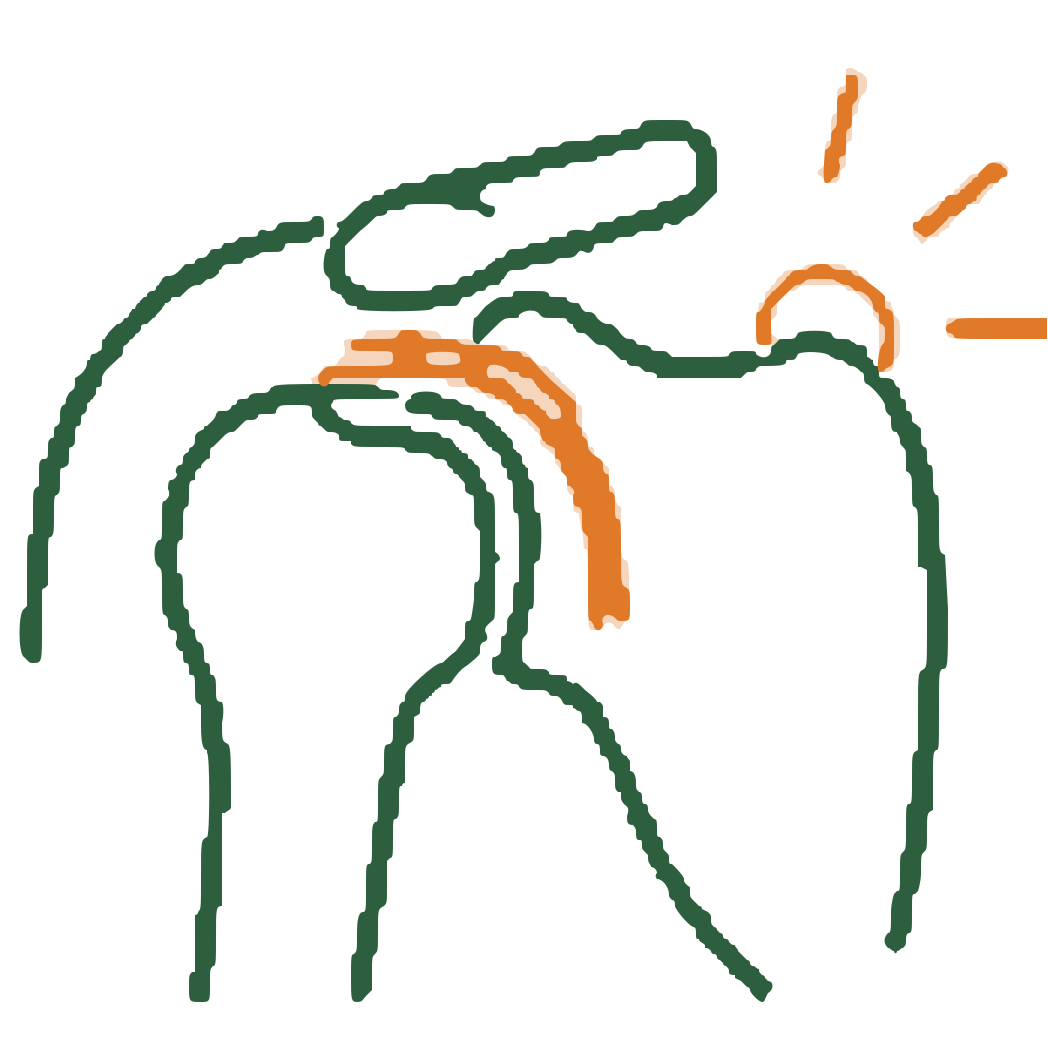
The rotator cuff is a cuff of tendons around the shoulder head. This cuff ensures stability and movement of the shoulder. These tendons are put under heavy strain when throwing a ball, hitting a golf shot, working for long periods above shoulder height or holding a heavy suitcase.
On this page4
A common picture is tendonitis (tendinitis) of the rotator cuff, with or without inflammation of the mucous membranes (bursitis).
Inflammation of the mucous membranes (bursitis)
The symptoms of acute bursitis occur in a few hours or days, often without an apparent cause or after an overload. The pain complaints are often severe and regularly disrupt sleep. The pain is usually in the shoulder and can radiate to the arm.
Because this is an excessive, useless and painful inflammation of the bursa, an injection with an anti-inflammatory often works well and is often sufficient. The complaints usually disappear within a few hours to days.
Tendinitis or tendon injury (tendinitis) of the rotator cuff
The complaints of a tendon injury of the shoulder are often related to movements of the shoulder. Painful include:
- lifting the arm sideways;
- overhead movements;
- to lie on the arm;
- taking something from a high cupboard;
- waves;
- lifting a maxi-cosi.
The traditional treatment is an injection with corticosteroids (cortisone), an anti-inflammatory. That can help in some cases, but there are a few snags.
A better treatment for long-term tendon complaints is prolotherapy. The treatment consists of a series of injections into the affected tendon and the surrounding tendons and ligaments with a glucose solution. This stimulates the body's own local healing response, which can repair the weakened tendon tissue. That healing process often takes a few weeks.
During the period of complaints, avoid movements above shoulder level, such as front crawling and window cleaning.
Rupture or tear of the rotator cuff
As the process of wear and tear and injury progresses, a cuff rupture can occur. A rotator cuff tear is regularly seen in patients over 60 years of age. This can be compared to an old elastic that has lost its elasticity and tears instead of springing back under load.
Once a tear has occurred, greater force is placed on the remaining tendons. This increases the risk of a new crack. This risk is especially high for active patients who still want to play golf or tennis.
Most patients with a complete tear of the rotator cuff cannot lift their arm independently due to loss of strength. Even daily activities then become difficult; tennis and golf are bad sports in that case.
We try to prevent this scenario. With prolotherapy to the remaining tendons we can strengthen them, heal inflammation and protect the tendons against strain, thus preventing further tearing.
Blog: is there little point in rotator cuff surgery?
Recognizable symptoms
- Pain when lifting the arm sideways
- Pain when moving overhead
- Pain when lying on the arm
- Pain when taking something from a high cupboard
- Severe shoulder pain that disrupts your night's sleep
- Pain that radiates from the shoulder to the arm
Scientific references (2)
- Bertrand H, Reeves KD, Bennett CJ, Bicknell S, Cheng AL. Dextrose Prolotherapy Versus Control Injections in Painful Rotator Cuff Tendinopathy. Arch Phys Med Rehabil. 2016 Jan;97(1):17-25.
- Lee DH, Kwack KS, Rah UW, Yoon SH. Prolotherapy for Refractory Rotator Cuff Disease: Retrospective Case-Control Study of 1-Year Follow-Up. Arch Phys Med Rehabil. 2015 Nov;96(11):2027-32.