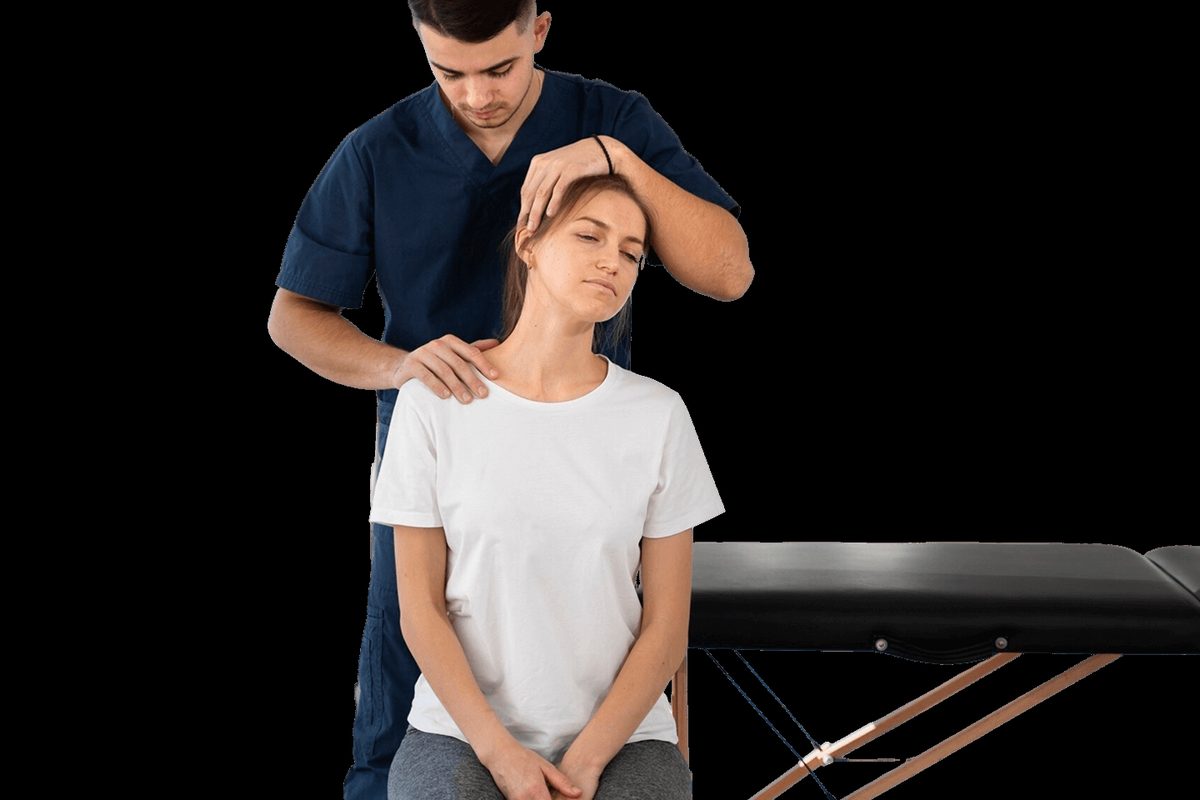
Chiropractic is the treatment with which our practice began in the late 1980s: manual correction of joint and spinal blockages. Before we treat, we discuss what we have found, the alternatives and the risks.
On this page11
How does it work?
We use fast, targeted impulses (the so-called high-velocity, low-amplitude thrust) to restore mobility to a blocked joint. The characteristic “cracking” is not a bone sound — it is a gas bubble escaping from the joint capsule, and does not affect the effectiveness of the treatment.
The treatment works in two ways: mechanically (the blockage is removed) and neurophysiologically (nerve irritation disappears). This relaxes surrounding muscles and the pain often decreases immediately.
We always carefully screen for contraindications via posture, movement and neurological tests. When in doubt, we opt for gentle techniques without cracking.
What can you expect?
Your first visit takes 30 minutes: a conversation, examination from high in the neck to the feet, a thermal scan, explanation of what we find and immediately the first treatment. A follow-up treatment takes approximately 20 minutes. The manipulation itself is usually painless; Sometimes the snapping feels strange for a moment, followed by a feeling of relief.
After the first treatments, you may experience mild muscle pain or fatigue for 24-48 hours — this is normal. Drink plenty of water and avoid heavy physical strain on the first day.
Scientific substantiation
Spinal manipulation is included in international guidelines (NICE, KNGF) as one of the treatment options for non-specific low back pain and neck pain. The American NCCIH reports that approximately 85% of chiropractic users use the treatment for pain complaints.
More about this treatment
Above you can read what happens during a manipulation. The question that really concerns most people remains: why is that joint stuck, and why won't it go away with a pill?
Why a blockage hurts so much
Many pain complaints arise from a mechanical blockage in the spine. A vertebra no longer moves properly. Patients often feel this themselves: something is twisted or displaced. Your muscles respond by tightening around that point. That tension makes you stiff and painful. This causes back pain, neck pain, radiation to an arm or leg, and even a hernia.
A tablet dampens the pain and exercises keep you moving, but neither loosens the joint. The cause remains. That is the mistake most often made.
Complaints that we handle
With a spinal block with possible nerve irritation, we often see:
 headache and neck painMore about Headache & migraine
- pain that radiates to an arm, and tingling in the arm
- pain between the shoulder blades
 low back pain, pelvic pain and buttock painMore about Low back pain
- radiation to the buttock, leg, calf and foot
Our approach
The only way to effectively treat these complaints is to release the painful blockage of the vertebrae with manipulations, so that the painful muscles can relax. If there is also a persistent muscle knot, we supplement the treatment with dry needling: a thin needle in the knot to speed up muscle recovery.
We also treat joints outside the spine with manipulation: shoulder, elbow, wrist, thumb and foot.
When loosening alone is not enough
This approach is ultimately sufficient for 75% of patients. The problem will then recover naturally within a few weeks.
In the other patients, the complaints are so chronic or severe that there is instability of the pelvis or vertebrae. In addition to manipulation and muscle work, prolotherapy or injection therapy is required. In this way we strengthen the overstretched, unstable ligaments — the bands that hold your vertebrae in place — so that the spine remains stable.
Our experience
We frequently use chiropractic and manual therapy in our practice. Our entire team followed in-depth education and training at home and abroad. What you get from us is a mix of chiropractic, manual therapy and manual medicine, based on more than 30 years of treatment experience.
This is how your first visit will go
Your first visit takes 30 minutes, from reception to first treatment. You always know what we do and why.
Reception
At the counter we will check your ID and health insurance card and immediately check whether you are insured.
Conversation
You tell us about your complaint: how long it has been going on, what you have done about it, what medications you use and when it bothers you most during the day.
Examine from head to toe
We examine your back, pelvis, hips and neck while standing, lying and sitting. You keep your shirt on; a headscarf may remain on.
Heat scan
With the Tytron heat scan we measure the skin temperature along your spine. You can see the result yourself on the screen.
Explanation and permission
We tell you what we have found, whether chiropractic suits you and what alternatives and risks there are. We will only start once you agree.
First treatment
During the same visit. Afterwards, some after-pain may occur; you often feel immediate relief.
Frequently asked questions
How many treatments do I need?
That depends on your complaint. We do not work with treatment series and you are not committed to anything: you only return if it makes sense for your complaint.
Do I have to undress for the examination?
No. You keep your shirt on, and a headscarf may remain on.
Is squatting painful?
No, not in general. Sometimes it feels uncomfortable for a moment, then a relief.
Can I work after treatment?
Yes. Sometimes you may feel slightly tired — that's normal. Avoid heavy physical strain for the first 24 hours.
Do I always have to keep coming?
No. Maintenance treatments are not an obligation; many patients only come for recurring complaints.
What does a chiropractor cost?
With us the first visit — consultation, examination and the first treatment straight away — costs € 90. A follow-up treatment costs € 70. Other practices charge different amounts; what applies with us is on the rates page. You hear beforehand what you pay, and nothing is added afterwards.
Does chiropractic have drawbacks?
Yes, and you hear about them beforehand. The most common is soreness afterwards: a day or two of stiffness or tenderness. That passes on its own. Serious complications are very rare; for treatment high in the neck we therefore ask for your consent separately. In the case of osteoporosis with a risk of fracture, a recent fracture, an infection or a tumour in the spine we do not treat with force — we then choose a gentle technique or another route. Tell us what is wrong with you and which medicines you take, including blood thinners.
How often may I come?
As often as makes sense for your symptoms, and no more than that. There is no fixed maximum and there is no obligation either: we do not work with courses of treatment and you are not tied to anything. If you notice nothing after a few treatments, we say so and think along with you about another route.
What is the difference with an osteopath?
Neither is “better” — they look at the body differently. A chiropractor focuses mainly on the joints of the spine and the nerves that run through it, using short, targeted techniques. An osteopath works more broadly and more gently, including on muscles and connective tissue. We do not provide osteopathy. If you are unsure which of the two suits your symptoms, call us; if your symptoms turn out not to belong with us, we say so.
Will it be reimbursed?
Through additional insurance, with chiropractors affiliated with RegisterChiropractor or SBC. Check your package via our reimbursement tool.
Chiropractic is performed by our experienced chiropractors, within a team with A.R. Mulder DC — registered chiropractor (RegisterChiropractor) — and BIG registered doctors. In the case of osteoporosis, recent fractures, instability or specific vascular disorders, we opt for gentle techniques or another treatment method.
Scientific references (2)
- Eklund, A., Hagberg, J., Jensen, I. et al. The Nordic maintenance care program: maintenance care reduces the number of days with pain in acute episodes and increases the length of pain free periods for dysfunctional patients with recurrent and persistent low back pain – a secondary analysis of a pragmatic randomized controlled trial. Chiropr Man Therap 28, 19 (2020). https://doi.org/10.1186/s12998-020-00309-6
- Bronfort G, Haas M, Evans R, Leininger B, Triano J. Effectiveness of manual therapies: the UK evidence report. Chiropr Osteopat. 2010 Feb 25;18:3. doi: 10.1186/1746-1340-18-3. PubMed PMID: 20184717; PubMed Central PMCID: PMC2841070.